Transforming Security Management Through Immersive Design
Role: Product Development, Principal 3D artist, Principle Production Manager
Challenge problem
McAfee users were struggling with fragmented, anxiety-inducing security experiences across their devices and accounts. Our research revealed that traditional dashboard interfaces were failing to engage users in meaningful security management.
Key Pain Points:
-
Fragmented Experience - Users were confused by McAfee's various products that didn't offer consistent experiences
-
Installation Friction - Users felt frustrated trying to download and install security applications across all their devices
-
Family Management Complexity - Users struggled to manage their family's security and understand protection levels across services
-
Security Anxiety - Users found interacting with security applications made them anxious, leading them to ignore their security entirely
The Core Problem: How might we transform security management from an anxiety-inducing chore into an engaging, intuitive experience?
Mobile 3D Dashboard Experience
The demo video of these new experiences on a Mobile device can be seen below.
Research and discovery
User Research Approach:
-
Conducted user interviews with 15+ existing McAfee customers
-
Analyzed support ticket patterns and user behavior data
-
Competitive analysis of security dashboard experiences
-
Stakeholder interviews with product and engineering teams
Key Insights:
-
Users wanted visual, spatial understanding of their security status
-
Traditional dashboards felt overwhelming and clinical
-
Users responded positively to gamification elements
-
Mobile-first approach was essential for family management scenarios
Design Hypothesis: By creating a 3D spatial interface, we could reduce cognitive load and transform security data into intuitive, interactive experiences that users actually want to engage with.


IA flows for Mobile dashboard UX
Concept development
Why 3D? Traditional 2D dashboards presented information as abstract data points. Our 3D approach transformed security concepts into familiar spatial metaphors:
-
Devices as physical objects in space
-
Protection levels as environmental lighting
-
Security actions as intuitive spatial interactions
Design Principles:
-
Spatial Intuition - Leverage natural spatial understanding
-
Reduced Anxiety - Make security feel approachable and manageable
-
Contextual Actions - Show what needs attention without overwhelming
-
Progressive Disclosure - Reveal complexity only when needed
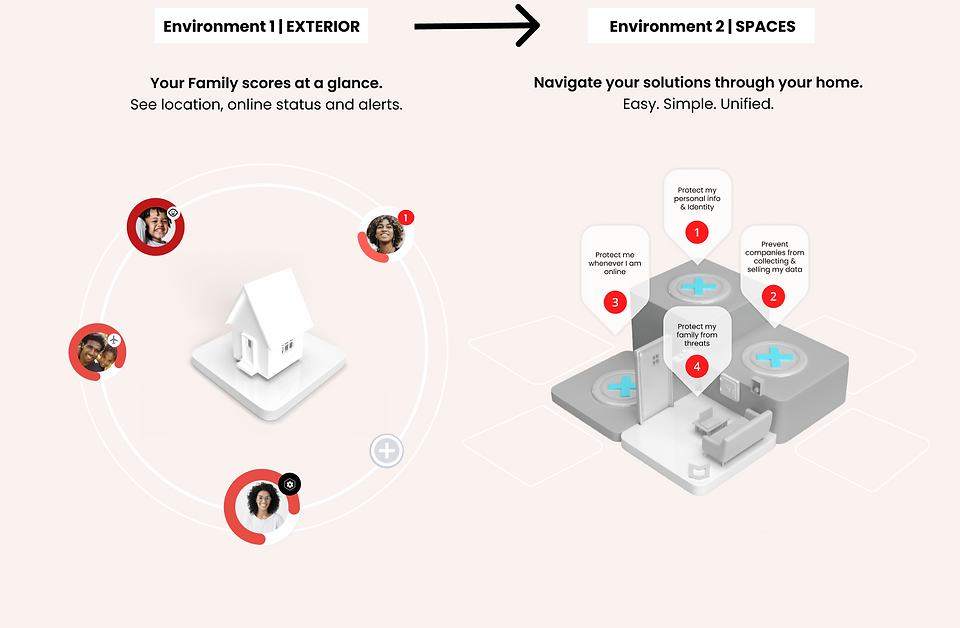
concept 3D illustration s for protected home

Concept 3D screens with mobile UI elements. Home Screen>>Secure zones>>adding protected device
3D Dashboard Experience The mobile dashboard presents the user's security ecosystem as an interactive 3D space. Users can orbit, pan, and zoom through their connected devices and accounts, represented as metaphorical objects in the environment.
Key Features:
-
Live 3D Environment - Real-time representation of security status
-
Interactive Protection Score - Users can set goals and see required actions
-
Device Visualization - Physical objects represent protected/unprotected devices
-
Contextual Alerts - Spatial notifications guide users to necessary actions

Notification flow for protection breach
Protection levels
Interactive Protection Score Innovation: Rather than a static metric, we made the protection score interactive. Users can rotate the dial to set protection goals, and the 3D space dynamically highlights what actions are needed to achieve the users goals.
Dashboard Capabilities:
-
Show protected vs. unprotected devices
-
Highlight devices needing activation
-
Push spatial alerts for specific devices
-
Suggest upgrades and new services contextually
-
Reward users with space decorations for completing tasks
-
Alert users about expiring subscriptions spatially

Mobie sctreen mockups for protection levels and notifications

User scenario samples for notification a nd user actions on protections
Desktop adaptation
Expanded Experience The desktop version maintains the mobile experience's simplicity while leveraging larger screen real estate for enhanced interaction.
Desktop Enhancements:
-
Transparent Modals - Floating security score with enhanced controls
-
Toolbar Integration - Additional functions without cluttering the 3D space
-
Multi-tasking Support - Ability to interact with multiple security aspects simultaneously
-
Enhanced Visualization - Larger space allows for more detailed device representations
Design Consistency: We maintained the core 3D metaphors while adapting interface elements for desktop interaction patterns, ensuring users could seamlessly transition between mobile and desktop experiences.

Verticle dashboard concept for iPad and Android
Vertical concept for iPad or Android tablet

Horizontal dashboard concept for iPad and Android
Results & Impact
Leadership Reception: The proof of concept received enthusiastic approval from McAfee's Director and VP of Design, who praised its innovative approach to transforming user engagement with security management.
Key Outcomes:
-
Strong Leadership Support - Concept gained approval from senior design leadership
-
User Engagement Potential - 3D metaphors successfully reduced cognitive load compared to traditional dashboards
-
Technical Feasibility - Proof of concept demonstrated smooth performance across mobile and desktop platforms
-
Design Innovation - Established new patterns for future McAfee product experiences
Project Status: Due to shifting company priorities and organizational changes, this innovative concept was placed on hold. The design patterns and research insights have been documented for future implementation opportunities.
Key Learnings
Design Insights:
-
3D interfaces can reduce anxiety when applied thoughtfully to complex data
-
Spatial metaphors help users understand abstract security concepts
-
Interactive goal-setting increases user engagement with security tasks
-
Mobile-first 3D experiences are technically feasible with proper optimization
Future Applications: The design patterns and user insights from this project have valuable applications for future security product development, particularly in areas requiring user engagement with complex, anxiety-inducing information.